The 2026 CGT reforms: what they mean if you're selling your business
The CGT changes are law from 1 July 2027. What Treasury said, and the question that decides whether the deadline is any use to you.
There is a deadline going round. Sell before 1 July 2027, or the new capital gains tax rules will cost you.
Treasury's own wording on the changes is worth reading before you let that date drive a decision this size. So is a question almost nobody is asking, which decides whether the deadline is any use to you at all.
What Treasury said
From Treasury's small business explainer:
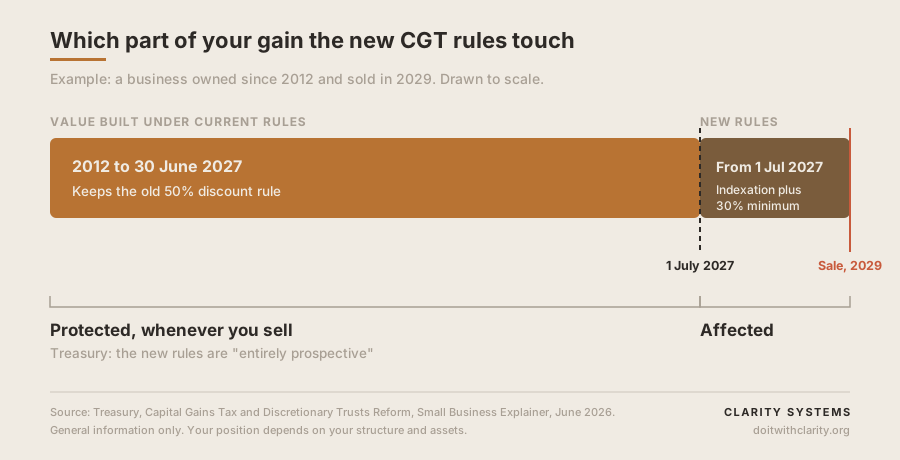
The new CGT rules don't start until 1 July 2027 and are entirely prospective. Any business value you build up before this date keeps the old 50 per cent discount rule, no matter when you sell in the future.
And on the concessions most business sales rely on:
The four small business capital gains tax (CGT) concessions are staying. If you sell your active business to retire, start a new business, or relocate, you can still reduce or completely remove tax on any gains if you meet the eligibility criteria.
One of those concessions got more generous. Treasury states that from 1 July 2027 the turnover threshold for the 50 per cent active asset reduction is increasing from $2 million to $10 million.
How any of this applies to your situation depends on your structure, your assets and whether a trust is involved. That is your accountant's call. What follows is the question we would want you to bring to them.
What is changing, and when
Three separate things get blended together in most coverage.
The current rules run until 30 June 2027 and nothing about a sale completed before then changes.
From 1 July 2027, the flat 50 per cent CGT discount for individuals, trusts and partnerships is replaced by a discount based on inflation, plus a 30 per cent minimum tax rate on real gains. This is law. The Treasury Laws Amendment (Tax Reform No. 1) Act 2026 (No. 49, 2026) received Royal Assent on 26 June 2026, having been introduced as a Bill on 28 May.
Two pieces are still being settled. A 30 per cent minimum tax on discretionary trusts applies for tax years commencing on or after 1 July 2028, and the Innovative Business CGT Concession went to consultation that closed in July 2026.
One more thing, and it only matters to a small group. If you have owned the business, or the premises it trades from, since before September 1985, those assets have sat outside capital gains tax entirely. The Act removes that from 1 July 2027. If that is you, it is worth a conversation with your accountant sooner rather than later.
Could you sell before 1 July 2027?
Work backwards from the date. In our experience a business sale of this kind runs for months rather than weeks, from first listing through to settlement, and the bigger the business the longer it takes. It is now July 2026. If a sale takes most of a year, settling before 1 July 2027 means being on the market around September or October. That is eight to 12 weeks away.
In those eight weeks you would need three to four years of financials clean enough for a stranger to read. Contracts and leases in writing rather than in your head. Licences checked for transferability, which is its own process and not a quick one. And you, personally, available to answer a couple of hundred buyer questions during due diligence while still running the business.
If that is genuinely doable, then the timing conversation with your accountant is worth having this week.
For most owner-led businesses it is not doable, and that is the point. The deadline was never really available. Selling in eight weeks is not a tax decision, it is an operational one, and the answer was set by how the business was built long before this Act existed.
What it costs to chase a date you cannot reach
Owners who try anyway tend to lose more than they save.
A business rushed to market arrives with gaps, and buyers price them in. Half-tidy financials turn due diligence into a three-month interrogation instead of a three-week check. Our guide to how a sale works walks through the loop where a long due diligence pulls the owner out of the business, the numbers soften, and the buyer revisits the offer.
Set that against what the tax change does. It alters the treatment of gains accruing after 1 July 2027. Everything built before then keeps its existing treatment, in Treasury's words, no matter when you sell. So a business sold in 2029 has only its final two years of growth touched by the new rules.
So anyone telling you to hurry is proposing you accept a discount on the whole price to protect a slice of the gain.
That's our read on it, and it comes from the sale side of the table. We spend our time on what a business is worth and whether it can be sold without the owner in the middle of it. We do not sit with an owner working through what a tax change means for their own position.
So we asked someone who does. Carl Maiorana is a senior financial adviser at 4C Wealth in West Perth, and he has been fielding the deadline question from owners since the Act passed in June.
The first question most owners ask is 'Should I sell before July 2027?'. The better question is 'How much more valuable could my business become over the next three years?' For most owners, that second question is worth far more money.
He is right, and it is worth seeing how much bigger.
The tax change touches the growth in your business after July 2027. The price touches all of it. So a difference of one turn in what a buyer is willing to pay will move more money than the reform ever will, on most sales.
So how do you make it worth more over three years?
Not by moving the market or the tax rate. Those are not yours to move. What is yours is the thing a buyer is really pricing, which is whether the business works when you are not in it. If the quoting, the key relationships and the decisions all run through you, a buyer sees it in due diligence and prices it, or holds part of the money back until the business proves it can survive your leaving.
That is the work, and it is slow. It is also why the deadline is a distraction. Three years of it changes what the business sells for. Three months of tax planning changes the arithmetic on an offer you have already been handed.
What to do instead
Ask your accountant which concessions you qualify for now, and what changes if you sell before or after commencement. Eligibility often turns on decisions made years earlier, such as how the business is structured and who owns the assets. Our guide to the small business CGT concessions covers the four in detail.
Get a documented valuation before 1 July 2027. Since value accrued before that date keeps its existing treatment, what the business is worth at that point matters, and it is easier to establish then than to reconstruct later.
Then work on the thing that moves the number most. If the honest answer to "could this run for three months without me" is no, that is worth more of your attention than the tax rate. It is also the work that makes the next window reachable, whenever you choose to use it. Our guide to owner dependency covers what buyers look for and what it costs them when they find it.
Frequently asked questions
What is the CGT tax on small business in 2027?
Current rules apply until 30 June 2027. From 1 July 2027 the flat 50 per cent discount is replaced by an inflation-based discount plus a 30 per cent minimum tax on real gains. The four small business CGT concessions continue, and the 50 per cent active asset reduction now reaches businesses up to $10 million turnover.
Will capital gains change in 2027?
Yes. The changes are law and commence 1 July 2027. Treasury describes them as entirely prospective, so value built before that date keeps its existing treatment.
How will CGT work after 2027?
Your cost base is indexed for inflation, so tax applies to the real gain rather than the nominal one, with a 30 per cent minimum rate. For business owners the small business concessions sit on top of that, and the ATO describes them as allowing you to reduce, disregard or defer some or all of a capital gain where the conditions are met.
Do the CGT changes apply to businesses?
Yes, with carve-outs. Treasury notes that everyday tools of trade such as work vans, computers and tools are not subject to CGT and are handled through standard income or deductions. The four small business concessions remain, and the active asset reduction threshold rises to $10 million.
How do I avoid CGT when selling a business?
A genuine gain cannot be made to disappear. The ATO describes the small business CGT concessions as allowing you to reduce, disregard or defer some or all of a capital gain from an active asset, and states that the 15-year exemption can disregard the gain where its conditions are met, including at least 15 continuous years of ownership. Eligibility depends on structure and timing, so raise it with your accountant early.
Does the 50 per cent CGT discount still apply in 2026?
Yes. It applies until 30 June 2027, and Treasury states that value accrued before that date keeps the old rule regardless of when you sell.
Sources
- Capital Gains Tax and Discretionary Trusts Reform: Small business explainerTreasury
- Tax reform: boosting home ownership, reforming negative gearing and capital gains taxAustralian Taxation Office
- Small business CGT concessionsAustralian Taxation Office
- Treasury Laws Amendment (Tax Reform No. 1) Act 2026, No. 49, 2026Federal Register of Legislation
Clarity Systems installs ClarityOS in owner-led businesses, so decisions, relationships and money stop running through the owner. The Independence Score is where you find out how close yours already is.
General information only. Not tax, legal or financial advice. This article summarises and quotes publicly available material published by Australian government bodies as at the date shown above, together with a quotation from a named third party reproduced with their written approval. It is general information only and does not take account of your objectives, financial situation or needs. It is not tax, legal, financial or accounting advice, and no advisory relationship is created by reading it. Clarity Systems is not a registered tax agent, licensed financial adviser or law firm, and is not authorised to provide tax or legal advice. Views attributed to third parties are their own and are general observations, not personal advice to any reader. Tax and legal outcomes depend on your entity structure, holding periods, timing and individual circumstances, and legislation and administrative practice change. Quotations from government sources are reproduced as published and may be superseded. You must not rely on this article as a substitute for advice from a qualified professional who has reviewed your circumstances. To the extent permitted by law, Clarity Systems and its officers accept no liability for any loss or damage arising from reliance on this article. Third-party sources are cited for reference and their inclusion is not an endorsement. Any figures mentioned are general illustrations only. They are not a valuation of any business, not an estimate of what your business would sell for, and not a representation about any outcome you might achieve. Business valuation depends on many factors specific to the business and the market at the time. Obtain a formal valuation from a qualified valuer.